Stour Valley Restore
We are excited to be developing a major new project that will aim to bring about a transition in the landscape of the Stour Valley. We are working with partner organisations, at a landscape scale, to bring about positive change for the Stour Valley’s important biodiversity and heritage.
What makes the Stour Valley special?
At the heart of the Stour Valley is a globally rare chalk stream – the Great Stour – which flows through the Kent Downs National Landscape, then out to sea via the internationally protected wetlands of the Lower Stour. The valley slopes are crowned by some of the south-east’s largest ancient woodlands. Designated habitats and farmland are critical strongholds for declining species. Historically, this landscape has played a pivotal role in our national story – an entry point for peoples and beliefs fundamental to our identity.
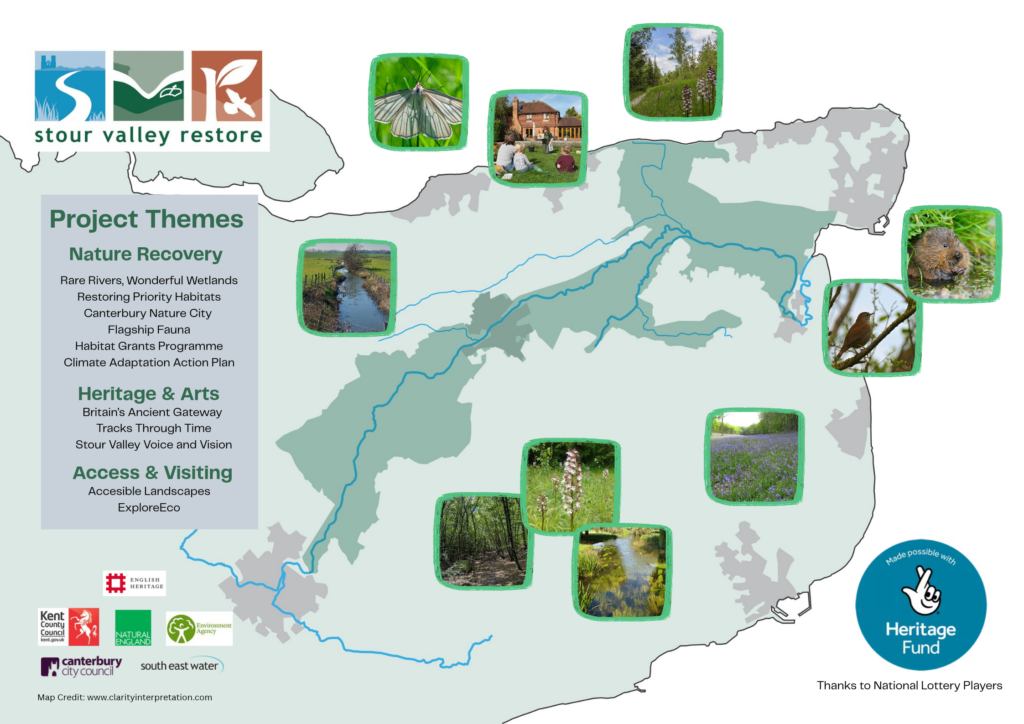
This map defines the landscape we will work in.
A LANDSCAPE AT RISK
The Stour Valley is under pressure from a number of directions. Its habitats are vulnerable to extreme weather, driven by climate change. Priority species are at risk from agricultural intensification and invasive species. The water environment, including wildlife-rich chalk streams and wetlands, is impacted by pollution and low flows. The landscape is under pressure from development, while habitats are impacted by disturbance – an issue worsening as population expands.

We want to bring protected sites into better condition in a more connected landscape, with habitat restoration and creation enhancing biodiversity and access. We want to help declining species to recover, with the help of local people. Community-driven measures to capture carbon, and make landscape and heritage sites more resilient to climate change, would also benefit wildlife and create new access for people. Water environment projects would improve rivers and wetlands and mitigate against flooding. We want to work with communities to take steps to improve the environment; they would take part in thriving community heritage, education and arts programmes and learn new skills through training.
DEVELOPMENT PHASE
After a successful application to the National Lottery Heritage Fund for an ‘Area Based Project’ (formerly known as a Landscape Partnership Scheme), we are now in the Development Phase of the scheme. With this grant, together with other contributions, we are working with our partners to develop 11 projects, to achieve a shared vision over a five year period across the Stour Valley.

Projects would be delivered under three themes.
OUR THEMES
Nature Recovery
We will work with landowners, site managers, and local authorities to improve habitat condition, climate resilience, and connectivity. We’ll engage communities in enhancing land for climate and biodiversity, and citizen science. We will also work with conservation organisations, landowners and communities, to deliver projects benefitting priority species, including control of invasive species. We’ll deliver community projects, including hands on conservation and volunteer surveys. The species we are focusing on include water voles, turtle doves, pollinator insects, hedgehogs, house martins, toads, beavers, migratory fish, and the super-rare Fisher’s estuarine moth.
Heritage and arts
Engaging people with the Stour Valley’s landscape heritage, particularly its neglected aspects. Promoting understanding of the significant role of this landscape, particularly the Wantsum Channel, in Britain’s history will be a central outcome, alongside site-specific activity.
Creative and art activities will deliver environmental education and arts-based programmes. There will be learning activities in nature for schools and community groups of all kinds will work with artists on digital and environmental art and creativity. This theme will particularly focus on removing barriers for people who may not usually engage with conservation and heritage.
Access and visiting
Focused on improving access to the landscape and promoting sustainable transport and tourism, this theme will deliver enhancements to greenspaces, access, and interpretation, and work with tourism and transport providers. It will make rights of way more accessible, deliver new facilities at gateway sites and relieve visitor pressures on heritage.
See more detail on our projects page.
JOIN US

We know how valuable the Stour Valley is and that its communities value it too. We are building a partnership with other organisations who are also working to protect it, and want to engage local people, community groups and landowners in joining with us. We believe that by working together we can restore this special landscape.
We are inviting organisations of all sizes to put forward initiatives and projects and come on board with the project. Partnership working will bring opportunities for bodies of all kinds to make projects that may have seemed out of reach a reality. We would like to hear about any idea that would fit one of our broad themes (which are set out above) and is associated with the core or scoping areas on the map above.
Our application
We are applying to the National Lottery Heritage Fund (NLHF) for a grant for an Area Based Project.
The process is in three phases:
Pre-Development Phase – We planned projects in outline, built our partnership and found match funding. At the end of this phase we submitted a Development Phase application.
Development Phase (July 2027 – November 2028) – this is the phase we are in now. It’s an 18 month period of work, funded by NLHF and others, where Delivery Phase projects are being planned in detail and further funding to match the grant for that phase is being sought. At the end of this phase we will submit a Delivery Phase application. If this is successful we will enter…
Delivery Phase (mid 2028 to mid 3033) – a 5 year period of work, funded by NLHF and others, where we deliver all our projects: award grants to landholders, undertake capital works to restore rivers and other habitats, help priority species, run community programmes, deliver creative and educational activities, improve access, promote sustainable transport and tourism…and everything else we are planning, plus develop the legacy for the project so that work will continue into the future.